A large filling, cracked cusp, severe wear or root-canal treatment can leave a tooth too weak for another filling, while a missing tooth creates problems with chewing, speech, tooth movement and cleaning. You will learn how crowns and bridges differ, which options fit different teeth and bite conditions, what treatment involves, and how to protect the result afterward.
Key takeaways
- A crown covers one damaged tooth or implant; a bridge replaces a missing tooth.
- Choose a crown when enough healthy tooth remains to support it.
- Ask how much tooth structure, bone, and gum support the restoration needs.
- Discuss cleaning methods, likely complications, and expected lifespan before treatment.
Crown or bridge: what does each restoration replace?
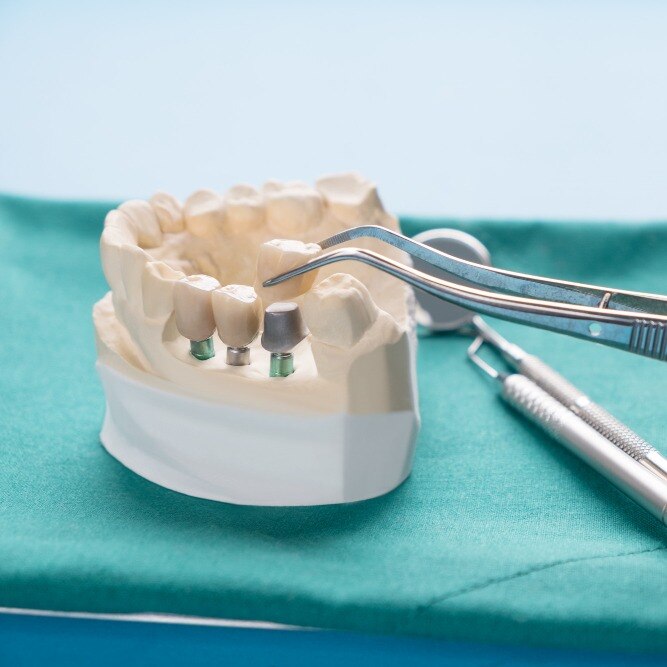
A dental crown covers one prepared natural tooth or an implant. It restores the visible portion of that single support; it does not replace a missing tooth. A dental bridge spans a gap by carrying an artificial tooth, called a pontic, on neighbouring abutment teeth or other supports.
| Option | What it replaces | What supports it |
|---|---|---|
| Crown | The damaged or weakened part of one tooth | A prepared natural tooth or implant |
| Bridge | The visible crown of one or more missing teeth | Crowned abutment teeth, retainers, or implants |
The pontic meaning in dentistry is the false tooth suspended within a bridge. A tooth-supported bridge replaces the crown, not the missing root, so bone shrinkage beneath the gap can continue.
Leaving a gap untreated can affect:
- Chewing, because nearby teeth must handle extra work
- Speech, especially when the missing tooth alters airflow
- Tooth position, as adjacent teeth can tip or drift into the space
- The opposing tooth, which can overerupt into the gap
- Jawbone volume at the missing-tooth site
- Cleaning access, because shifted teeth and the area beneath a pontic collect plaque more easily
When is a crown better than another filling?
A tooth needs a crown when its remaining walls and cusps cannot safely withstand chewing, but enough sound structure remains to support coverage. A large filling, a cracked tooth cusp, severe wear or extensive decay can weaken the tooth until cuspal coverage is safer than another filling.
The decision depends on the amount and position of sound enamel and dentine, not simply the size of the cavity.
- Filling: Choose it when the tooth has strong walls and cusps, and repairing the defect will not remove more healthy structure.
- Bonding: Use it for a small chip or limited shape change when adhesive resin can restore the area conservatively.
- Veneer: Consider it for selected front-tooth damage or discolouration when the tooth remains structurally sound; it does not protect every weakened cusp.
- Crown: Use it when substantial cuspal coverage is needed to hold the tooth together.
A back tooth takes heavy vertical and sideways chewing forces, so a root canal tooth crown is commonly considered after significant structure has been lost. A front tooth may face lower biting loads, allowing conservative restoration when the access cavity is small and the remaining tooth is strong.
Crown preparation removes enamel and dentine irreversibly, so compare a crown or filling with bonding or a veneer before choosing.
Which bridge type suits a missing tooth?
A bridge uses a pontic—the artificial tooth—to fill the visible gap. Abutment teeth or implants support it through crowns, wings or other retainers, while the cleanable gap beneath the pontic still needs daily attention.
| Option | Main trade-off | When it may suit |
|---|---|---|
| Traditional fixed bridge | Strong, but requires filing neighbouring abutment teeth for crowns or retainers | When those teeth already need crowns and have sound roots, gums and bone |
| Cantilever bridge | Uses one side for support, so chewing forces concentrate on one abutment | Selected positions with controlled bite forces, not heavy back-tooth loading |
| Maryland bridge | Maryland bridge advantages and disadvantages include preserving more tooth structure but risking debonding | Front-tooth gaps with suitable abutment shape, position and bite |
| Implant-supported bridge | Avoids filing neighbouring teeth, but requires surgery, adequate bone and implant maintenance | Several missing teeth when health, bone and cleaning ability support treatment |
Other types of dental bridges include a removable partial denture, which you remove for cleaning. For one missing tooth, an implant-supported crown avoids joining adjacent teeth but still involves implant surgery and maintenance.
Leaving the space untreated can be reasonable when chewing, speech and tooth position remain acceptable. A dentist must still monitor movement, overeruption, cleaning access and bone loss before choosing no replacement.
How does a dentist decide whether the tooth or bridge can support treatment?
Suitability starts with the tooth’s foundation, not its appearance. For dental bridge suitability, the dentist examines remaining tooth structure, cracks, decay and whether root-canal treatment is needed. An X-ray before crown placement checks hidden decay, root condition and bone support. For a bridge, abutment teeth need adequate strength, healthy gums and stable supporting bone.
- Assess space, neighbouring teeth, bite forces and the position of the missing tooth. Grinding, smoking and difficulty cleaning increase the risk of failure and may change the plan.
- Treat active decay, gum disease or infection before preparation. An unrestorable tooth, inadequate support or a back-tooth gap exposed to heavy forces may require an implant, removable option or extraction instead.
- Prepare the tooth or abutment teeth, then take a conventional impression or digital scan. A temporary crown or bridge protects the prepared area while the laboratory fabricates the final restoration.
- Trial-fit the restoration to check its margins, contacts, shade and appearance. The dentist then cements it and adjusts the bite so it does not receive excessive force.
The crown and bridge procedure only succeeds when you can clean around the margins and beneath a pontic. If support remains doubtful, postponing treatment to control disease or choosing a different restoration is safer than cementing a predictable failure.
What can happen after fitting, and how long can the result last?
Mild crown sensitivity after fitting and slight bite discomfort often settle as the tooth and surrounding tissues adapt. A high spot can make the tooth feel taller or cause pain on chewing; contact the dentist for an adjustment instead of waiting.
If a temporary crown or bridge becomes detached, seek prompt advice because the exposed prepared tooth can shift, break or become sensitive.
Crown and bridge complications include recurrent decay at the crown margin, fracture, wear, loss of retention, gum inflammation and periodontal problems around abutments. An abutment-tooth fracture can make a replacement bridge more complex, especially if the tooth is no longer restorable. A loose dental bridge needs assessment, even when it causes no pain.
Published studies report decade-scale survival for many fixed restorations, not a lifetime guarantee. How long do dental crowns last? The answer depends on:
- Grinding, heavy bite forces or an unfavourable tooth position
- Acidic diets and sticky foods
- Smoking, plaque and gum disease
- Poor cleaning beneath a pontic or around crown margins
- Missed examinations, hygiene care and bite maintenance
Fluoride toothpaste, daily cleaning and scheduled reviews help protect the restoration and its supporting teeth.
What should you ask before choosing a crown or bridge?
Start with the decision, not the material: one missing tooth, several missing teeth, a front tooth and a back tooth do not carry the same demands. Healthy neighbouring teeth may suit a bridge, while compromised teeth may favour an implant or removable option.
At Kaira Dental Care & Implant Centre, use the consultation to compare these choices rather than assume a conventional bridge is least invasive.
Questions to ask before a dental crown or questions to ask before a dental bridge include:
- What do the X-rays show about decay, roots, bone and abutment strength?
- What restoration type and material do you recommend, and how much tooth preparation is needed?
- What are the alternatives, total charges and crown and bridge maintenance requirements?
- What happens if an abutment fractures, decays or becomes unrestorable?
- Should bleaching happen before shade selection?
| Option | Best question to compare | Main trade-off |
|---|---|---|
| Conventional bridge | Are neighbouring teeth strong and cleanable? | No surgery, but requires tooth preparation |
| Implant-supported restoration | Is bone, health and cleaning ability adequate? | Preserves adjacent teeth, but involves surgery and maintenance |
| Removable partial denture | Are several teeth missing or surgery unsuitable? | Less invasive, but removable and less stable |
Clean daily with fluoride toothpaste, then use floss threaders, Superfloss, an interdental brush or a water flosser to learn how to clean under a bridge. Seek review for swelling, spontaneous pain, a fractured crown, a loose bridge or bleeding around supporting teeth.
Related service
Crown and Bridge Treatment Dr. Ashi Agarwal, a skilled Dental Surgeon at her clinic on Wagbil Road, Kavesar, Thane West, offers high-quality Crown and Bridge Treatment to... View service → |
Frequently asked questions
What does a crown replace, and what does a bridge replace?
A crown covers one prepared natural tooth or implant and restores its visible portion. A bridge spans a gap by supporting an artificial tooth, called a pontic, on abutment teeth or other supports.
When is a crown better than another filling?
A crown is considered when a tooth has lost too much structure for a filling to protect it reliably, especially after extensive decay, a large filling, or root canal treatment. Your dentist must assess the remaining tooth structure first.
Which bridge type suits a missing tooth?
The choice depends on the gap, the position of the missing tooth, neighbouring tooth health, bite forces, bone support, and cleaning access. Options include traditional, cantilever, Maryland, and implant-supported bridges.
How does a dentist decide whether treatment can be supported?
The dentist examines the tooth or abutments, gums, bite, X-rays, remaining tooth structure, and available bone. They also check for decay, cracks, mobility, infection, and habits such as grinding.
What can happen after fitting, and how long can crowns or bridges last?
Temporary sensitivity, gum tenderness, bite imbalance, loosening, chipping, or decay at the margins can occur. Longevity depends on hygiene, bite forces, materials, support, and regular dental reviews rather than a fixed guarantee.